

Table of Contents
- Why Your Hips Hurt When You Sit Cross-Legged
- How to Sit Comfortably During Meditation: The Alignment Fix
- The Best Meditation Cushion for Hip Pain: What to Look For
- Stretches for Meditation Hip Pain: A Pre-Sit Routine
- Alternative Meditation Positions for Hip Relief
- Managing Discomfort During Long Sessions
- Conclusion: Building a Sustainable Practice
- Frequently Asked Questions
Last Updated: September 25, 2026
Why Your Hips Hurt When You Sit Cross-Legged
Learning how to stop hip pain during meditation usually starts with compression, not weakness. Fold your legs, drop your pelvis backward, and the hip joint runs out of room, producing a front-of-hip pinch that builds with every minute you sit.
The problem is mechanical: your hip joint has a limited range before bone meets bone or soft tissue gets pinched, and sitting cross-legged pushes you toward that limit. If your pelvis tilts back and your knees float above the floor, the pressure lands on the front of the hip capsule.
A common mistake is forcing the knees down to "open" the hips. That move grinds the joint instead of freeing it.
The Anatomy of Hip Impingement in Meditation
Hip impingement is the pinching of soft tissue or bone at the front of the hip joint when the thigh bone and pelvis meet at a sharp angle. In meditation, this happens when the hip flexes, rotates inward, and the pelvis tips backward all at once.
The femur's ball sits in a socket in your pelvis. Sit cross-legged and it rotates until the neck of the femur presses against the rim of the socket; extra bone or a deep socket makes this worse.
This is why some people feel a sharp catch at the front of the hip and others feel nothing. It is anatomy, not toughness.
How to Sit Comfortably During Meditation: The Alignment Fix
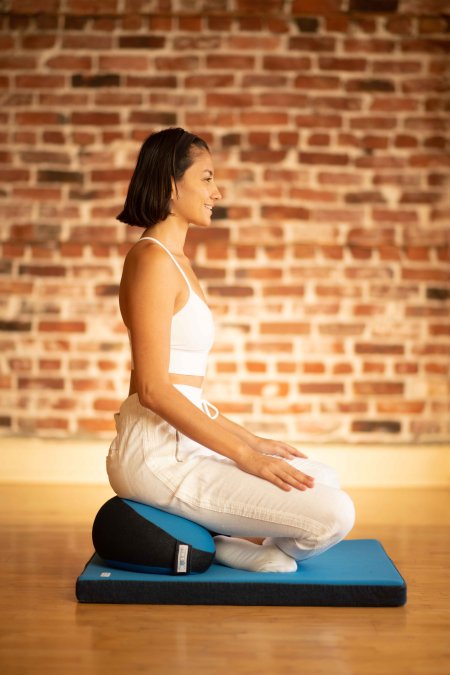
The fastest way to sit comfortably during meditation is to raise your hips above your knees. When the pelvis sits higher than the legs, it tips forward on its own. The spine stacks, and the pinch at the front of the hip releases.
Most hip pain comes from a backward-tilted pelvis: the lumbar spine rounds, the chest caves, and the hip joint closes. Raising the seat reverses all three.
Here is the fix in order:
- Sit on a firm surface, not a soft couch
- Raise the hips until the knees drop below the hip crease
- Let the sit bones rest evenly on the cushion
- Stack the spine and relax the belly
- Check that the knees are not higher than the hips
If your knees still float above your hips after all that, your cushion is too low. That is the whole diagnosis.
Pelvic Tilt and Spinal Stacking
Think of the pelvis as a bowl: tilt it forward and the spine stacks; tilt it back and everything above it collapses.
Spinal stacking is the practice of aligning the pelvis, ribcage, and head so each rests over the one below it. When the pelvis tips forward slightly, the natural curve of the lower back returns. The ribcage settles over the hips. The head balances on top.
This alignment takes effort off your muscles. Your skeleton holds you up instead of your back muscles fighting gravity.
The Best Meditation Cushion for Hip Pain: What to Look For
The best meditation cushion for hip pain raises your hips above your knees and stays firm enough to hold that height for the full sit. Soft foam that squashes flat defeats the purpose. But "firm enough" is not a feeling, it is a set of measurable specs you can check before you buy.
Here are the specs that actually matter, in order of impact on hip pain:
1. Height above the floor (the single biggest variable). Measure from the floor to the top of the cushion under your sit bones, not the unstuffed height. For most adults, 4 to 6 inches of lift is the working range: under 4 inches the pelvis tips back and the hip joint closes, while over 6 inches the hip flexors and inner thighs strain to stabilize you. Taller people or those with long femurs need the upper end; shorter people the lower end.
2. Fill material and how it behaves under load. Buckwheat hulls shift and lock into your shape, molding to your sit bones and staying put. Foam compresses and stays compressed, a 5-inch foam cushion can measure 3 inches once you sit on it. Kapok packs down faster than buckwheat, and cotton batting is the worst for hip support, so buckwheat is the default for a reason.
3. Fill volume and adjustability. A cushion you can open and remove hulls from beats a sealed one, because your ideal height changes with the surface, hardwood and carpet need different fill levels. Look for a zippered inner liner so you can tune height without spilling hulls.
**4.
Zafu Height, Buckwheat Fill, and Hip Support
A zafu is a round, firm meditation cushion traditionally filled with buckwheat hulls. Height matters more than any other spec. Too low and the pelvis tips back. Too high and the knees strain.
- Sit on it for 10 minutes and check whether your knees are at or below your hip crease.
- Press down with both sit bones, the cushion should give slightly and then hold, not bottom out.
- Lean side to side, the fill should shift with you and stay where it lands.
- Stand up and look at the cushion, if it has flattened to half its height, it is too soft for hip support.
Stretches for Meditation Hip Pain: A Pre-Sit Routine
Knowing how to stop hip pain during meditation with stretches works best when they target the two things that limit cross-legged sitting: hip external rotation and hip flexion range. Five minutes of targeted movement before practice can prevent an hour of discomfort, but only if the moves match the mechanism.
general hip mobility guidance from a physical therapy association
Try this routine before you sit, in this order:
- Figure-four stretch, 30 seconds per side. Lie on your back, cross one ankle over the opposite knee, and pull the uncrossed thigh toward your chest. This targets the glutes and the external rotators, which is the range cross-legged sitting demands most.
- Butterfly pose, 1 minute, gentle. Sit tall, soles of the feet together, and let the knees fall. Do not press the knees down. This opens the adductors, which is what lets the knees drop below the hips.
- Cat-cow, 10 slow rounds. This is not a hip stretch; it is a spinal warm-up so the pelvis can tilt freely once you sit.
- Seated forward fold, 30 seconds. Targets the hamstrings, which pull on the pelvis from behind and can limit forward tilt.
- Hip circles, 10 each direction. Standing or on hands and knees, this moves the joint through its full range under control, which is the point of a warm-up.
Progressive Mobility for Hip Flexors and Glutes
Mobility is not the same as flexibility. Mobility is your joint's ability to move through its full range under control. Flexibility is just length. A hip that is long but uncontrolled will still pinch when you load it by sitting.
A simple progression:
- Week 1-2: hold stretches 30 seconds, no force. Goal is consistency, not range.
- Week 3-4: add gentle hip rotations and start holding 45 seconds. Goal is control at the end of your current range.
- Week 5+: add light strength work like glute bridges and clamshells. Goal is strength at end range, which is what keeps the joint from collapsing when you sit for 30 minutes.
Alternative Meditation Positions for Hip Relief
Cross-legged sitting is not the only option. If your hips will not cooperate, change the position instead of fighting it.
- Chair meditation: sit with feet flat, hips slightly above knees
- Kneeling: use a bench or cushion between the heels
- Supine meditation: lie flat with knees bent or supported
- Walking meditation: slow, deliberate steps
Managing Discomfort During Long Sessions
You can also break a long sit into shorter blocks: sit 20 minutes, stand and move for 2, then sit again.
Conclusion: Building a Sustainable Practice
The challenge is not sitting still. It is sitting in a way your body can repeat tomorrow, next week, and next year.
Frequently Asked Questions
Why do my hips hurt when I sit cross-legged for meditation?
Hip pain in cross-legged meditation usually comes from two things: a lack of hip mobility and insufficient pelvic support. When your pelvis tilts backward, the lumbar spine rounds and your hip joints bear uneven pressure. Tight hip flexors and weak glutes make it worse. Elevating your hips above your knees with a cushion reduces this strain significantly. If pain persists or radiates down your leg, see a physical therapist to rule out hip impingement or nerve compression.
What is the best meditation cushion for hip pain?
The best meditation cushion for hip pain elevates your pelvis above your knees and provides firm, moldable support. A buckwheat-filled cushion works well because it conforms to your body and holds its shape. Kusha Cushions' Moon cushion is designed to support the hips and thighs with a crescent shape that naturally aligns the spine, and the Earth base cushion adds soft support for knees and ankles. Together they create a stable seat that reduces hip pressure during long sits.
Are there specific stretches to do before meditation to prevent hip pain?
Yes. A short pre-sit routine helps. Progressive mobility work can warm the connective tissue around the hip joint and reduce stiffness.
How can I use a meditation cushion to relieve hip pressure?
Place a firm cushion under your pelvis so your hips sit higher than your knees. This tilts the pelvis forward slightly, which straightens the lumbar curve and removes strain from the hip joints. A crescent-shaped cushion like the Moon supports the thighs and encourages a natural upright posture. If you need extra knee and ankle support, add a flat base cushion underneath. Adjust the height until you feel your weight balanced on your ischial tuberosities, not your tailbone.