

Table of Contents
- Why Standard Cushions Fail Tall Practitioners
- Meditation Cushion Height Guide: Matching Cushion to Leg Length
- Zafu vs Zabuton for Tall People: Which Setup Works Best?
- How to Sit Comfortably During Meditation with Long Legs
- Top Cushion Options for Tall Practitioners
- Comparison Table: Cushion Options at a Glance
- Frequently Asked Questions
Last Updated: September 27, 2026
Why Standard Cushions Fail Tall Practitioners
If you have long legs, a standard meditation cushion is often too low to do its one job: raising your hips above your knees. At Kusha Cushions, we have spent 20 years providing cushions to the meditation community, and the most common complaint from tall sitters is not discomfort. It is that their hips sink below knee level, which tilts the pelvis backward and rounds the lower spine. The result is a posture that fights gravity for the entire session.
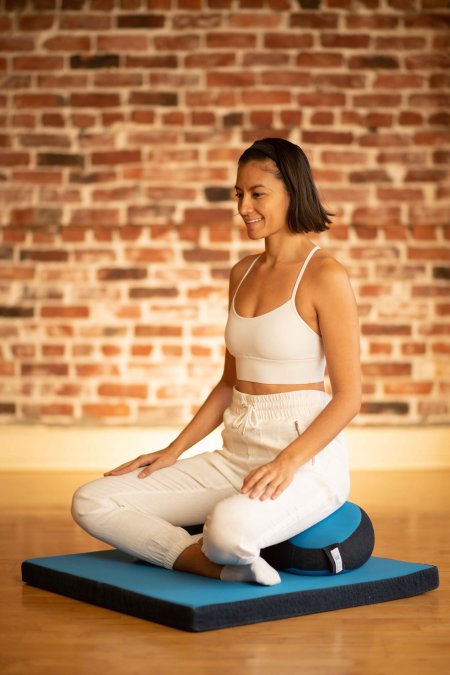
The best meditation cushion for tall practitioners solves this with height, not softness. A taller seat lifts the pelvis so the knees can drop toward the floor, which restores the natural inward curve of the lower back. Get that angle right, and sitting still stops being a battle.
The Hip Elevation Problem
Hip elevation is the single variable that decides whether a tall sitter can relax. When the hips sit level with or below the knees, the pelvis rolls back and the spine follows. Most standard zafus top out around 4 to 5 inches, which suits average frames but leaves long femurs fighting for space.
Joint Pain and Long Legs
Long legs also mean more weight pressing through the knees and ankles. A thin cushion forces those joints into sharp angles, and after 10 minutes the ache pulls your attention away from the breath. The fix is a wider, firmer base that spreads pressure across the shins rather than concentrating it at the knee.
Meditation Cushion Height Guide: Matching Cushion to Leg Length
The right cushion height for a tall practitioner is generally 6 inches or more at the top of the seat, with a wide base underneath to support the legs. But height alone is not the whole answer. What actually determines whether a tall sitter can relax is the relationship between three measurements: your lower-leg (tibia) length, your upper-leg (femur) length, and the angle your hips can open into cross-legged sitting.
Here is the mechanism. When you sit cross-legged, your knees need to drop to or below the level of your hip joints. If they do not, the pelvis rotates backward (posterior tilt), the lumbar curve flattens, and the upper back rounds to compensate. Tall practitioners have longer femurs, which means the knees start higher and need more seat height to clear the hips. That is why a 4-inch zafu that works for a 5'4" sitter leaves a 6'2" sitter slumped within minutes.
As a working ratio, aim for roughly 1 inch of seat height for every 6 to 7 inches of lower-leg length. Measure your lower leg from the floor to the top of your knee while seated cross-legged, that number tells you more than any generic height chart.
| Lower-Leg Length | Suggested Seat Height | Femur Consideration | What It Fixes |
|---|---|---|---|
| Under 17 in | 3-4 in | Short femurs, easy knee drop | Basic hip lift for shorter frames |
| 17-19 in | 4-5 in | Average femur length | Standard zafu range |
| 19-21 in | 5-6 in | Longer femurs need more clearance | Knee drop for longer legs |
| Over 21 in | 6 in+ | Long femurs, high knee stack | Pelvic tilt and lower-back curve |
Two adjustments matter as much as raw height. First, seat width: a 15-inch round zafu works for most sitters, but if your thighs splay wide when you cross your legs, a crescent or wider seat keeps the knees from hanging off the edge and pulling the hips forward. Second, fill density: a tall sitter often carries more body weight, and a soft fill compresses under that load, dropping you an inch or more within the first ten minutes. Buckwheat hulls hold their shape under heavier frames far better than cotton or foam, which is why most tall-friendly setups use hulls in the raised seat and a firm foam or hull base underneath.
A common pattern among tall practitioners is to buy the tallest cushion available and still feel unsupported, because the fill gave out.
Zafu vs Zabuton for Tall People: Which Setup Works Best?
For tall practitioners, the best setup is usually a zafu (the round, raised seat) on top of a zabuton (the flat, rectangular base), not either one alone. The zafu handles hip elevation. The zabuton handles knee and ankle cushioning. Skip the base and your knees take the full load of your longer legs; skip the raised seat and your pelvis never gets high enough.
How to Sit Comfortably During Meditation with Long Legs
Sitting comfortably with long legs comes down to four adjustments you can make before your next session:
- Raise the seat until your hips clear your knees by an inch or more.
- Slide the cushion back so your sit bones rest on the front third, not the center.
- Let the knees fall below the hips, using a base cushion under the shins.
- Tilt the pelvis slightly forward to restore the lower-back curve.
Top Cushion Options for Tall Practitioners
The best meditation cushion for tall practitioners pairs a raised, moldable seat with a wide, supportive base. The three setups below are built around that principle, and each one suits a different sitting style.
Earth Sun Bundle: Buckwheat Support with a Sturdy Base
Our top pick for most tall sitters is the Earth Sun bundle, which combines a 2-inch, 28" x 28" Earth base with a 6-inch-high, 15-inch-wide Sun cushion. That 6-inch seat is the height most long-legged practitioners need, and the buckwheat hulls inside the Sun mold to your body so the cushion does not fight your sit bones. The Earth base spreads your knees and ankles across a wide, firm surface, which takes the pressure off long shins.

Earth Moon Bundle: Crescent Shape for Wider Leg Postures
The Earth Moon bundle swaps the round Sun for the crescent-shaped Moon, a 5-inch-high, 12-inch-deep, 18-inch-wide seat filled with buckwheat hulls. The crescent shape supports the hips and thighs and helps align the spine, especially for wider leg postures where the knees splay outward. Tall practitioners who sit in a broad cross-legged position often find the Moon's shape more forgiving than a round seat.

Earth Base Cushion: A Foundation for Existing Setups
If you already own a raised seat that works, the Earth cushion is the missing half. This 2-inch, 28" x 28" base is filled with premium high-resiliency foam and covered in the same indigo-dyed bull denim. It supports the knees, legs, and ankles so you can meditate without pain, and it works as a foundation for the Sun and Moon cushions.

Comparison Table: Cushion Options at a Glance
Here is how the three setups compare on the specs that matter most for tall practitioners.
| Setup | Seat Height | Fill | Price | Best For |
|---|---|---|---|---|
| Earth Sun Bundle | 6 in (Sun) | Buckwheat hulls | $135.00 | Most tall sitters, maximum lift |
| Earth Moon Bundle | 5 in (Moon) | Buckwheat hulls | $135.00 | Wider leg postures, splayed knees |
| Earth Base | 2 in | High-resiliency foam | $80.00 | Adding support under an existing seat |
Frequently Asked Questions
Do tall people need a higher loft meditation cushion?
Yes. Taller practitioners typically need a cushion between 5 and 7 inches high to elevate the hips above the knees. When hips sit lower than the knees, the pelvis tilts backward, straining the lower spine. A higher loft supports a natural forward pelvic tilt and keeps the spine upright. For very tall users, pairing a 5 to 6 inch buckwheat cushion with a 2 inch base cushion provides the elevation needed for extended sessions without ankle or knee discomfort.
What is the difference between a zafu and a zabuton for taller practitioners?
A zafu is the round or crescent cushion that raises the hips, while a zabuton is the flat rectangular mat underneath that cushions the knees, ankles, and feet. Tall practitioners benefit from using both because long legs need more support along the shins and ankles. A buckwheat-filled zafu molds to the body for firm support, and a foam-filled zabuton absorbs pressure where legs contact the floor. Together they reduce joint strain during long sits.
How does height affect the choice of a meditation cushion?
Height determines how much lift your hips need to sit above your knees. Someone under 5 feet 6 inches may sit comfortably on a 4 inch cushion, while someone over 6 feet often needs 6 inches or more. Leg length matters as much as overall height. A simple test: sit cross-legged on the floor. If your knees sit higher than your hips, add cushion height until your hips tilt slightly forward and your spine can stack naturally.
What features should tall practitioners look for in a meditation cushion?
Prioritize cushion height of at least 5 to 6 inches, a firm fill like buckwheat hulls that holds its shape, and a wide base that accommodates longer thighs. A removable, washable cover matters for daily use. Look for a handle for transport. A base cushion underneath adds knee and ankle support that tall bodies need during extended meditation.
Can a meditation cushion help with knee and hip pain during long sessions?
A properly sized cushion reduces strain by elevating the hips and aligning the pelvis, which takes pressure off the knees and lower back. When hips sit above the knees, the legs rest without being forced down, and the spine can stack with less muscular effort. Buckwheat hulls conform to your shape and hold firm, while a foam base cushions contact points. If pain persists, try a seiza bench or vary your sitting position between sessions.