

Table of Contents
- Why Daily Practice Demands a Durable Meditation Cushion
- Quick Comparison: Kusha Cushions for Daily Sitting
- Zafu vs Zabuton for Daily Practice: Which Setup Lasts?
- Materials That Determine How Long a Cushion Lasts
- How to Clean Buckwheat Hull Meditation Cushions Safely
- Matching Cushion Firmness and Shape to Your Body Type
- Travel and Space-Saving Options for Daily Practice
- Conclusion
- Frequently Asked Questions
Last Updated: September 28, 2026
Why Daily Practice Demands a Durable Meditation Cushion
A cushion that flattens after three months of daily sitting isn't a cushion, it's a countdown. Most meditators replace cheap floor cushions within a year because the fill compresses, the seams pull, or the cover wears through at the hip crease. Durable meditation cushions for daily practice hold their height and shape through hundreds of hours of use.
NIH research on meditation and mind-body practices
Quick Comparison: Kusha Cushions for Daily Sitting
The right daily setup depends on how and where you sit. Kusha Cushions builds four configurations, from a simple base to a portable full set.
| Product | Price | Fill | Best For |
|---|---|---|---|
| Earth | $80.00 | High-resiliency foam | Knee and ankle support base |
| Moon | $70.00 | Buckwheat hulls | Hip and thigh alignment |
| Earth Moon Bundle | $135.00 | Foam plus buckwheat hulls | Complete daily seat |
| The Cloud | $250.00 | Memory foam and closed-cell foam | Practice on the go |
Zafu vs Zabuton for Daily Practice: Which Setup Lasts?
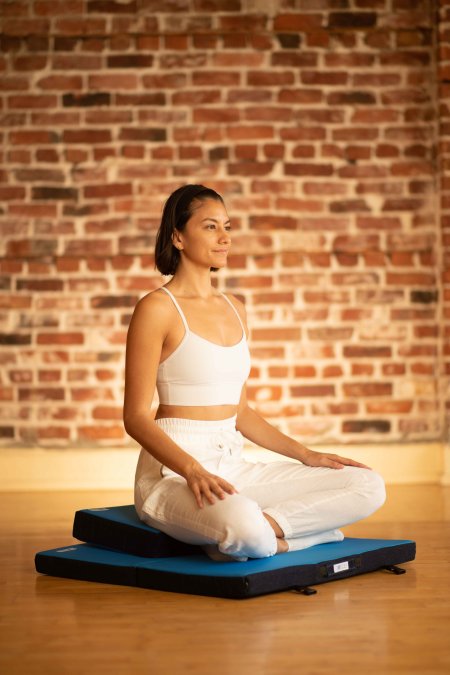
A zafu is the raised, round or crescent cushion you sit on; a zabuton is the flat rectangular mat underneath that cushions your knees and ankles. For daily practice, the pairing matters more than either piece alone.

Materials That Determine How Long a Cushion Lasts
Fill and cover construction decide whether a cushion survives daily use. The useful question isn't "which material is best", it's "how does this material fail, and how long does it take?" Every cushion eventually degrades; the material determines whether that happens in months or years, and whether you can repair it or must replace the whole thing.
How each fill actually wears out
- Buckwheat hulls: Hulls are rigid, so they don't compress the way foam does, they shift, settle, and slowly break down under repeated loading. In daily use, a hull cushion holds its loft for years but needs topping off as the fill settles. The failure mode is gradual and reversible: add hulls and you're back in business. Look for clean hulls free of dust and chaff, since dusty fill migrates through seams and irritates the skin.
- High-resiliency foam: This fill separates a cushion that lasts from one that doesn't. High-resiliency (HR) foam is graded by density, commonly pounds per cubic foot, and the higher the density, the more load it takes before a permanent set. Low-density foam is the biggest reason cheap cushions go flat within a year: it compresses past recovery and never bounces back. HR foam holds its height far longer, but once it fatigues you replace the insert, not the cover.
- Memory foam composites: Memory foam contours to the body, which feels supportive at first, but it is heat-sensitive and softens in warm rooms. That makes it a poor choice for a fixed daily base and a reasonable one for a portable seat used in short sessions. Expect a shorter service life than HR foam under continuous weight.
- Cover fabric: The cover shows daily wear first, usually at the hip crease and the seam where the top meets the side. A 14 oz bull denim resists abrasion there far better than thin cotton twill, and four-way stretch nylon adds flex where knees and ankles press without splitting. Fabric weight and weave matter more than color or print.
The construction details that predict lifespan
Material choice sets the ceiling; construction decides whether you reach it. Three details separate a daily-sitting cushion from an occasional-use one:
- Reinforced seams and bar-tacked stress points. The hip crease and the handle attachment are where stitching pulls first. Bar tacks spread that load instead of letting a single stitch take it.
- A separate inner hull bag. A removable liner keeps hulls contained, makes topping off easy, and lets you wash the outer cover without touching the fill.
- A replaceable insert. If the fill is a separate component, a fatigued base can be refreshed without discarding the cover, which is both cheaper and less wasteful.
A quick way to compare two cushions before you buy
Ask three questions. First, what is the fill density or hull grade, not just the fill type? Second, is the insert replaceable, or is the fill sewn in? Third, what does the warranty cover, the cover, the workmanship, or the fill? A cushion that answers all three is built to be maintained rather than replaced. Kusha Cushions builds on 30 years of professional upholstery experience, and every product carries a lifetime guarantee on the cover and workmanship.
How to Clean Buckwheat Hull Meditation Cushions Safely
Never machine wash the hulls. Water ruins buckwheat, causing mold and a smell you cannot remove. Unzip the cover, remove the inner hull bag, and clean each part separately.
EPA guidance on indoor air quality and moisture control
Matching Cushion Firmness and Shape to Your Body Type
Most cushion guides tell you to "choose based on comfort." That's not actionable. What determines whether a cushion works is seat height relative to your hip flexibility and proportions, and you can measure both at home before you buy.
Measure your hip hinge before you shop
Sit on the floor with your legs crossed and your sit bones on a folded blanket or firm pillow. Notice where your knees land relative to your hips:
- Knees at or above hip level: Your hips are tight or your legs are long relative to your torso. You need a taller seat, roughly 4 to 6 inches of lift, to raise the pelvis above the knees so the lumbar curve can return.
- Knees clearly below hip level: Your hips are relatively open. A lower seat, around 2 to 3 inches, keeps you from tipping forward and over-arching.
- Knees level with hips: You're in the middle range. A 3 to 4 inch seat usually stacks the spine with the least effort.
Match the seat to your proportions, not just your height
Once you know your hinge range, factor in leg and torso length:
- Long legs, short torso: You need more lift to clear the knees, but a tall seat can push your low back into extension. A crescent shape that supports the thighs lets you sit higher without losing the lumbar curve.
- Short legs, long torso: A lower seat keeps the pelvis neutral, but a flat round cushion may let the knees drop too far. A wider base under the seat takes the load off the hip joints.
- Heavier sitters: Buckwheat hulls distribute weight better than foam and won't bottom out, because the hulls rearrange rather than compress. Pair them with a firm, dense foam base so the foundation doesn't fatigue.
- Knee or ankle discomfort: The seat height is only half the setup. A base cushion under the knees and ankles keeps those joints on soft foam instead of the floor, which matters more the longer you sit.
Firmness is a separate decision from height
Height fixes your pelvis angle; firmness fixes your contact pressure. Too soft and your sit bones sink until your spine rounds; too firm and you get pressure points and cut-off circulation in the legs. The target is a seat that holds your pelvis level for a full session without shifting. If you're constantly adjusting mid-session, the cushion is fighting your anatomy, no amount of willpower fixes a geometry problem.
A two-minute self-test
Sit on your current setup for five minutes without moving, then check three things: Are your knees at or below hip level? Is your low back naturally curved, or are you slumping or over-arching? Are your sit bones comfortable, or are you leaning to one side? Any "no" points to a fix, height for the first, firmness for the second, shape for the third.
Cleveland Clinic overview of posture and spine health
Travel and Space-Saving Options for Daily Practice
Portable practice used to mean sitting on whatever was available. The Cloud changes that. At 5.7 pounds with a shoulder strap, it's the only mobile meditation cushion set of its kind, built for studios, retreats, or outdoors.
Conclusion
The hardest part of a daily practice isn't the sitting, it's finding support that doesn't quit after a few months. A cushion that holds its shape, keeps your spine stacked, and survives years of use turns intention into consistency.
Frequently Asked Questions
What features make a meditation cushion durable for daily practice?
Look for high-resiliency foam or tightly packed buckwheat hulls, a removable cover in dense fabric like 14 oz bull denim, and reinforced stitching at stress points. A cushion that rebounds after sitting and holds its shape for years is the real test. Kusha Cushions offers a lifetime guarantee on cover and workmanship, which signals confidence in long-term durability.
How do you maintain a buckwheat hull meditation cushion?
Spot-clean stains with soap and water, then machine wash the removable cover in cold water and dry on low heat. Keep the hulls dry and refill or top them off if the cushion flattens over time. For step-by-step guidance, see our section on how to clean buckwheat hull meditation cushions safely without damaging the fill or fabric.
Is a zafu or zabuton better for daily practice?
They serve different roles. A zafu raises the hips to tilt the pelvis forward for upright posture, while a zabuton cushions the knees and ankles underneath. For daily practice, many meditators use both together. The Kusha Moon sits on the Earth base cushion to combine hip elevation with soft joint support in one setup.
Are meditation cushions worth the investment?
A well-made cushion protects your joints and posture during long sits, which makes daily practice easier to sustain. Cheap cushions that flatten within months cost more over time. Kusha Cushions range from $70 to $250, and the lifetime guarantee on cover and workmanship means you replace it once, not every year.
What is the best cushion for a larger body type?
Firmer fills and a wider base work best. Buckwheat hulls mold to the body and hold firm without bottoming out, while a 28-inch base like the Kusha Earth spreads weight across a larger surface. The Moon cushion sits lower and suits wider leg postures, so bigger meditators get hip support without sinking through.