

Table of Contents
- Why Standard Cushions Fail Tall Meditators
- Meditation Cushion Height: Finding Your Ideal Seat
- Meditation Cushion Size Guide for Tall Frames
- Best Meditation Cushion for Hip Flexibility
- Meditation Bench for Tall People: When to Choose One
- Fill Materials and Firmness: Buckwheat vs. Foam
- Top Picks: Kusha Cushions for Tall Meditators
- Conclusion
- Frequently Asked Questions
Last Updated: October 9, 2026
Why Standard Cushions Fail Tall Meditators
If you're tall, the cushion that works for everyone else is probably working against you. Standard meditation cushions are built for average frames, so past six feet your hips sit too low, your knees float, and your lower back takes the load instead of your skeleton.
The physics are simple: a cushion has to raise your pelvis above your knees so your spine can stack upright on its own.
Meditation Cushion Height: Finding Your Ideal Seat
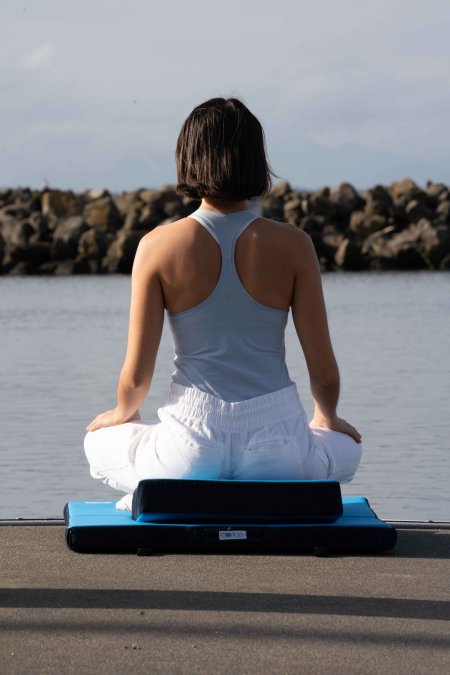
The right meditation cushion height puts your hips level with or slightly above your knees when you sit.
Height is the single biggest lever you have. Get it right and the rest of your posture tends to organize itself.
How Height Affects Hip and Pelvic Elevation
Hip elevation lets the pelvis rotate forward into a neutral tilt. When the pelvis tips forward, the natural curve of the lower back returns and the spine stacks without muscular effort. When it tips backward, the lower back rounds and the deep hip muscles work overtime.
For a tall frame, that backward tilt shows up fast: extra femur length means the knees sit higher relative to the hips on a standard cushion, the exact geometry that pulls the pelvis back.
A Practical Height Chart for Tall Frames
Use the chart below as a starting point, then adjust for the caveats that follow.
| Your Height | Starting Seat Height (after compression) | Notes |
|---|---|---|
| 5'10"-6'0" | 4.5-5 inches | Often fine on a standard high zafu |
| 6'0"-6'3" | 5-5.5 inches | May need a stacked or taller cushion |
| 6'3"-6'6" | 5.5-6 inches | Stacking a base under a top cushion is common |
| 6'6" and up | 6-7 inches | Consider a two-piece setup or a bench |
Three caveats matter more than the chart itself:
- Leg length vs. total height. Two people the same height can have very different femur lengths. If your knees sit high even at the chart's number, go up half an inch.
- Hip mobility. Tight hips need more height to reach the same forward tilt; flexible hips can sit lower and stay neutral.
- Preferred posture. Cross-legged sitting usually needs more height than a wide, splayed posture, because crossed legs raise the knees further.
Why Compression Changes the Number
Every cushion loses height once you sit on it. A buckwheat cushion might start at 6 inches and settle to 5.5 under a heavier sitter; foam can lose more, in the same spot every session. That's why the chart lists seat height after compression. To measure yours, sit for a minute, slide a ruler under your sit bones, and compare. More than half an inch below target? Add fill or a base layer.
What Elevation Can and Can't Do
A cushion can change the angle of your pelvis and take load off your lower back. It cannot fix a hip impingement, treat a disc issue, or replace medical advice. If cross-legged sitting causes sharp pain, numbness, or tingling that doesn't resolve when you shift, change position or talk to a clinician, don't buy a taller cushion.
Meditation Cushion Size Guide for Tall Frames
Size matters as much as height for tall meditators. A cushion that's too small forces your knees off the edge, removing their support and pushing your weight back onto your tailbone. Three dimensions matter: seat height, surface width (whether thighs and knees rest fully), and base footprint (a tall sitter carries more weight higher up, so a wider base prevents tipping).
As a starting point for taller frames:
- Seat height of 5 to 6 inches after compression
- A sitting surface at least 15 inches wide
- A base footprint of 28 inches or more for stability
- A fill that molds rather than bottoms out
Crescent vs. Round vs. Wedge Shapes
Shape decides how the cushion meets your legs. A round cushion (the classic zafu profile) gives even support in every direction and suits meditators who shift position often. A crescent cushion slopes down at the front and back, letting the thighs angle downward and taking pressure off the inner knees. A wedge cushion tilts the whole pelvis forward, suiting sitters with very tight hips.
Best Meditation Cushion for Hip Flexibility
The best meditation cushion for hip flexibility does some of the work your hips can't. If your hips are tight, the cushion has to create the forward pelvic tilt for you.
Coming from a firm foam cushion, expect the first few sessions on a molding fill to feel different, it moves with you instead of holding a fixed shape. Most people stop noticing within a week.
Meditation Bench for Tall People: When to Choose One
A meditation bench for tall people is the better choice when cross-legged sitting isn't available to you. Benches put you in a kneeling posture, removing the need for hip rotation entirely.
Choose a bench if:
- You have limited hip flexibility or a history of hip or knee injury
- Cross-legged sitting causes knee pain within minutes
- You prefer an upright, kneeling posture
- You need to change positions often during long sits
Choose a cushion if:
- You can sit cross-legged comfortably for at least a short session
- You want a lower, more grounded sitting position
- You need something portable for travel or outdoor practice
- You want to build hip flexibility over time
The honest limitation: benches load the knees and ankles differently, and some people find that harder than cross-legged sitting. Neither option is universally better. It depends on where your body complains.
Fill Materials and Firmness: Buckwheat vs. Foam
Fill decides how the cushion behaves over a long sit, and how long it stays supportive. Tall shoppers often carry more weight concentrated on a smaller contact area, so a fill that compresses permanently fails faster for them.
How Each Fill Behaves Under Load
Buckwheat hulls mold to your body and can be adjusted by adding or removing fill. The hulls redistribute as you settle, so the cushion responds to your sit bones instead of flattening under them, and they compress less than foam and recover their loft between sessions. The trade-off is weight: a full-size buckwheat cushion can run 7 to 10 pounds.
Foam holds a fixed shape and compresses in the same spot session after session. High-resiliency (HR) foam resists that better than standard foam, but no foam recovers like hulls do.
Weight Capacity and Compression
Most cushion makers don't publish a weight rating. What you can check instead:
- Fill volume. A cushion listed at 6 inches high with a small fill volume will bottom out faster than one with more hulls. Look for a stated fill weight or the option to buy extra fill.
- Refill options. Buckwheat cushions that sell replacement hulls separately are the most durable choice, because you can restore height instead of replacing the whole cushion.
- Shell construction. A double-stitched seam and a sturdy inner liner hold up better under repeated compression than a single-seam cover.
- Cover fabric. A heavier denim or canvas cover resists stretching at the seams, where compression failures usually show up first.
A buckwheat cushion used daily by a heavier sitter typically needs a top-up every 12 to 18 months; a foam cushion in the same conditions may need replacing in that window instead.
Firmness Is a Setting, Not a Ranking
Firmness is a personal setting, not a quality ranking. Too soft and you sink until your hips drop below your knees; too firm and you get pressure points. Adjustable fill lets you tune it, which is why we favor buckwheat for the main seat. For tall meditators, err slightly firmer than you think you want, a firmer seat holds the height you paid for, and you can always remove a cup or two of hulls.
Pairing Fills: Foam Base, Buckwheat Top
Foam works well as a base layer. A high-resiliency foam pad under the main cushion supports the knees and ankles, which matters when your legs are long and your knees sit far from your hips. The foam base takes the floor contact and ankle pressure; the buckwheat top does the molding and the height. That split is why a two-piece setup tends to outlast a single cushion for tall sitters.
| Setup | Fill | Best For | Height |
|---|---|---|---|
| Earth base + Sun | Foam base, buckwheat top | Cross-legged sitting | 2" + 6" |
| Earth base + Moon | Foam base, buckwheat top | Wider leg postures | 2" + 5" |
| Earth alone | High-resiliency foam | Knee and ankle support under any cushion | 2" |
Top Picks: Kusha Cushions for Tall Meditators
Our top pick for tall meditators is a two-piece setup: stacking a base cushion under a shaped top cushion gives you adjustable height, full leg support, and a fill that molds to your frame.

Earth Sun Bundle: Best for Cross-Legged Sitting
The Earth Sun Bundle is our pick for tall meditators who sit cross-legged.
Both covers are 14 oz indigo-dyed bull denim with a four-way stretch nylon panel. They're stain and soil resistant, spot-clean with soap and water, and machine washable in cold water on low heat.
At $135 for the pair, it's the setup we'd recommend first for most tall sitters.
Earth Moon Bundle: Best for Wider Leg Postures
The Earth Moon Bundle suits tall meditators who sit with a wider leg posture. The Moon cushion is crescent-shaped, measuring 5 inches high by 12 inches deep by 18 inches wide, and sits lower than the Sun, better when your legs splay wider, since it keeps the thighs angled downward without forcing the knees together.

The same Earth base sits underneath, adding 2 inches of foam support for the knees, legs, and ankles. The Moon also has a handle for transport. At $135 for the bundle, it's the better choice if your natural sitting position is wide rather than crossed.
If you already own one piece, the Moon cushion alone is $70 and the Earth base alone is $80.
For tall meditators, height and width matter more than brand or price. Get the hips above the knees, give the legs full support, and choose a fill that molds rather than flattens.
Conclusion
Sitting tall in meditation shouldn't mean fighting your own frame.
Kusha Cushions builds for exactly that. The Earth Sun Bundle and Earth Moon Bundle both pair a supportive foam base with a buckwheat-filled top cushion, so you get adjustable height and lasting comfort in one setup.

Get started with Kusha Cushions and build a sitting practice your body can actually hold.
Frequently Asked Questions
What is the best meditation bench for tall people?
Kusha Cushions does not offer benches, but their Earth Sun Bundle provides similar elevation and support for cross-legged sitting.
How high should a meditation cushion be for a tall person?
The Sun cushion from Kusha Cushions is approximately 6 inches high, which suits many tall users. Pair it with the Earth base for added stability and knee support.
Is a zafu or meditation bench better for tall people?
It depends on your flexibility and sitting preference. A zafu (round cushion) like the Sun cushion promotes cross-legged sitting and hip opening, while a bench allows a kneeling posture with no ankle strain. Tall people with tight hips may find a bench easier, but a crescent cushion like the Moon offers a middle ground with wider leg support.
What cushion shape works best for cross-legged meditation?
Crescent-shaped cushions, such as the Moon cushion, are ideal for cross-legged meditation because they support the thighs and hips while accommodating wider leg postures. Round cushions like the Sun also work well for those who prefer a traditional zafu. Both can be paired with the Earth base for extra comfort.