

Table of Contents
- Why Cushion Height Matters for Your Meditation Practice
- Understanding Cushion Loft and How It Affects Spinal Alignment
- Meditation Cushion Height for Tight Hips: Finding Your Sweet Spot
- Zafu vs Zabuton Height Differences: Which Setup Works Best
- Measuring Your Ideal Cushion Height by Body Type and Position
- How to Sit Comfortably During Meditation: Adjusting Height for Neutral Posture
- Material Degradation and Long-Term Cushion Height: What to Expect
- Conclusion
- Frequently Asked Questions
Last Updated: October 2, 2026
Why Cushion Height Matters for Your Meditation Practice
Your meditation cushion isn't just a comfort accessory, it's the foundation for sustainable practice. When the height is wrong, your hips tilt backward, your spine curves, and your mind spends the entire session fighting physical discomfort instead of settling into stillness.
At Kusha Cushions, we've spent 20 years providing cushions to the community and 25 years in meditation practice, and the pattern is consistent: practitioners who choose the right cushion height report deeper focus, longer sessions without pain, and a practice that actually feels sustainable. The difference between a cushion that's too low and one that's properly proportioned for your body can mean the difference between a five-minute session cut short by hip pain and a forty-minute meditation where your spine stays naturally aligned.

The stakes are real. Sitting on a cushion that's too flat forces your knees higher than your hips, which tilts your pelvis backward and collapses your lumbar spine. Over weeks and months, this builds tension in your lower back and hips. Conversely, a cushion that's too high can strain your neck and shoulders. Finding your ideal cushion height means understanding how loft, body type, and sitting position work together to support neutral posture.
Understanding Cushion Loft and How It Affects Spinal Alignment
Cushion loft is the height of the cushion when it's fully compressed under your body weight. This is different from the cushion's uncompressed height, what matters is how high it sits when you're actually sitting on it.
Loft directly controls the angle of your pelvis. When your hips are elevated properly by the cushion, your pelvis tips forward naturally. This forward tilt allows your spine to stack vertically, with each vertebra aligned above the one below it. Your cervical spine (neck) stays neutral, your shoulders relax, and your lower back maintains its natural curve instead of collapsing into flexion.
The relationship is straightforward: too little loft and your pelvis tilts backward, flattening your lumbar spine and forcing your shoulders to round forward to compensate. Too much loft and your knees lift off the ground, destabilizing your base and creating tension in your hips and lower back. The goal is finding the height where your pelvis tips forward just enough that your spine naturally straightens without effort.
Different materials affect how loft translates to actual support. Buckwheat hulls, used in Kusha Cushions' Sun and Moon cushions, compress slightly under body weight but maintain consistent support throughout your session. High-resilience foam, like that in the Earth cushion, provides a firmer base that doesn't compress further as you sit. Understanding your cushion's fill material helps you predict how its loft will feel during practice.

Meditation Cushion Height for Tight Hips: Finding Your Sweet Spot
If your hips are tight, you need more loft than someone with open hips. Tight hip flexors and external rotators limit how far your legs can fold, which means your knees sit higher relative to your hips. Without enough cushion height, you end up in a compromised position where your pelvis can't tip forward, no matter how hard you try.
The solution isn't to force deeper hip opening before you sit. It's to choose a cushion height that accommodates your current range of motion while you work on hip flexibility separately. This is where many practitioners get stuck: they buy a low cushion thinking it will help them "grow into" deeper hip opening, then spend months in poor posture that actually tightens their hips further.
Start with the assumption that you need more height than you think. If you're sitting cross-legged and your knees are higher than your hips, you need a taller cushion. The Kusha Cushions Sun cushion, at approximately 6 inches high, works well for practitioners with moderate hip tightness. If your knees still sit high, layering the Sun on top of the Earth cushion creates approximately 8 inches of total height, which accommodates tighter hips while still allowing your pelvis to tip forward.
One practical test: sit on your current cushion and notice where your weight lands. If you're balancing on your sit bones with your knees dropping sharply, the cushion is too low. If your knees are nearly level with your hips and you feel stable, you're in the right range. Adjust cushion height incrementally, even 1-2 inches makes a significant difference in how your spine aligns.
Zafu vs Zabuton Height Differences: Which Setup Works Best
A zafu is the round meditation cushion you sit on. A zabuton is the larger rectangular mat underneath, designed to support your knees and ankles. Understanding how these work together clarifies why height matters.
The zafu provides the primary loft that tilts your pelvis. The zabuton cushions your knees and ankles, reducing pressure on joints if you're sitting in seiza (kneeling position) or if your knees don't fold completely in cross-legged position. Together, they create a complete support system.
Height-wise, the zafu does the heavy lifting. A typical zafu ranges from 4-6 inches high, depending on your needs. The zabuton adds minimal height, usually less than 1 inch, but it's essential for comfort during longer sessions. If you're sitting without a zabuton and your knees are pressing into the floor, you're creating unnecessary pressure that will eventually cause pain.
The Kusha Cushions Earth Sun bundle combines these functions: the Earth cushion (2 inches high, 28" × 28") serves as your zabuton foundation, and the Sun cushion (6 inches high) sits on top as your zafu. Used together, they provide 8 inches of total height with the Earth cushion's broad base distributing pressure across your knees and ankles. This setup works particularly well for practitioners with tight hips or those planning to sit for extended periods.
If you prefer a lower profile, the Moon cushion (5 inches high, 12" deep × 18" wide) is designed for people with a wider leg posture and sits slightly lower than the Sun. The Moon's crescent shape supports your thighs while still tilting your pelvis forward. Placing it on the Earth cushion gives you 7 inches of total height with a different weight distribution than the Sun setup.

| Cushion Setup | Total Height | Best For | Spinal Support |
|---|---|---|---|
| Sun alone | 6 inches | Moderate hip tightness, shorter sessions | Good forward pelvic tilt |
| Moon alone | 5 inches | Wider leg posture, open hips | Gentle forward pelvic tilt |
| Earth + Sun | 8 inches | Tight hips, longer sessions, knee support | Optimal forward pelvic tilt + joint cushioning |
| Earth + Moon | 7 inches | Wider posture, longer sessions | Forward pelvic tilt + knee support |
Measuring Your Ideal Cushion Height by Body Type and Position
Start with this baseline: when you sit on your cushion in your preferred position, your hips should be 1-2 inches higher than your knees. This creates the forward pelvic tilt that allows your spine to stack vertically.
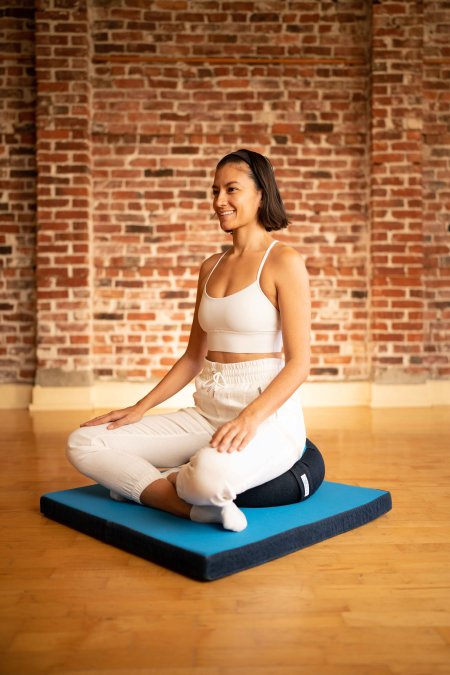
Measure this by sitting on your cushion and placing your hands on your hip bones and knees. If your hips are lower than your knees, your cushion is too low.
How to Sit Comfortably During Meditation: Adjusting Height for Neutral Posture
Neutral posture is the goal, and cushion height is the primary tool to achieve it. Neutral means your spine maintains its natural curves without effort, your cervical spine (neck) isn't craned forward, your thoracic spine (mid-back) isn't rounded, and your lumbar spine (lower back) isn't collapsed.
Material Degradation and Long-Term Cushion Height: What to Expect
Cushion materials compress over time. Buckwheat hulls settle and compress slightly with use. Foam cells break down gradually under repeated compression. This means your cushion's height will decrease over months and years.
Conclusion
Choosing the right cushion height is the single most important decision you'll make for your meditation setup. It determines whether your spine stays neutral, whether your hips can open gradually, and whether you can sit comfortably for the duration you need.
Frequently Asked Questions
How does cushion height affect spinal alignment during meditation?
Cushion height directly influences whether your spine remains neutral and upright. When the cushion loft is correct for your body, your hips sit higher than your knees, naturally straightening your spine and reducing strain on your cervical spine and lower back. Too low a cushion forces your spine to round forward; too high creates excessive curve. Proper height reduces pressure points and allows you to maintain posture without muscular effort.
Should I choose a higher or lower cushion if I have tight hips?
Tight hips typically benefit from a higher cushion. A taller loft elevates your hips more, reducing the angle your hips must achieve to sit cross-legged. This decreases tension in the hip flexors and allows your knees to rest closer to the floor. Many practitioners with hip tightness find that a 6-inch cushion like the Sun cushion provides better comfort than a lower 5-inch option, as it requires less hip flexibility while still maintaining spinal alignment.
What is the standard height range for meditation cushions?
Standard meditation cushions typically range from 4 to 6 inches in height. The Moon cushion sits at 5 inches and works well for practitioners with wider leg postures or greater hip flexibility. The Sun cushion reaches 6 inches and suits those needing more elevation for tight hips or larger body frames. When paired with a base cushion like the Earth, which adds 2 inches, the total height can reach 8 inches for maximum support.
How do I know if my meditation cushion is too low?
Your cushion is likely too low if your hips sink below your knees, forcing your spine to round forward, or if you experience hip, knee, or ankle pain after just a few minutes of sitting. You might also notice neck strain or difficulty maintaining an upright posture without muscular tension. If you find yourself shifting positions frequently or unable to focus because of physical discomfort, a higher cushion height will likely resolve these issues.
The right cushion height transforms your practice from something you endure to something you actually look forward to. Kusha Cushions' handcrafted meditation cushions are designed specifically to support neutral posture and sustain comfort through longer sessions. With a lifetime guarantee on cover and workmanship, you're investing in a cushion that will maintain its height and support for decades. Shop The Cloud and experience how proper cushion height makes meditation genuinely sustainable.